
Pandarus - the Sophist of Love?
What would Troilus and Criseyde do if he didn't play Cupid?

Hello, dear Reader.
For this post, I have returned to the love story of Troilus and Criseyde.
As I read through Books 2 and 3 this time around, something about their courtship really struck me.
Their courtship is really all Pandarus’ doing.
As Criseyde’s uncle, Pandarus, describes Troilus to her, he thinks to himself:
Thanne thoughte he thus, “If I my tale endite
Ought hard, or make a proces any while,
She shal no savour have therinne but lite,
And trowe I wolde hire in my wil bigile;
For tendre wittes wenen al be wile
Theras they can nought pleinly understonde:
Forthy hir wit to serven wol I fonde.” (267-273)
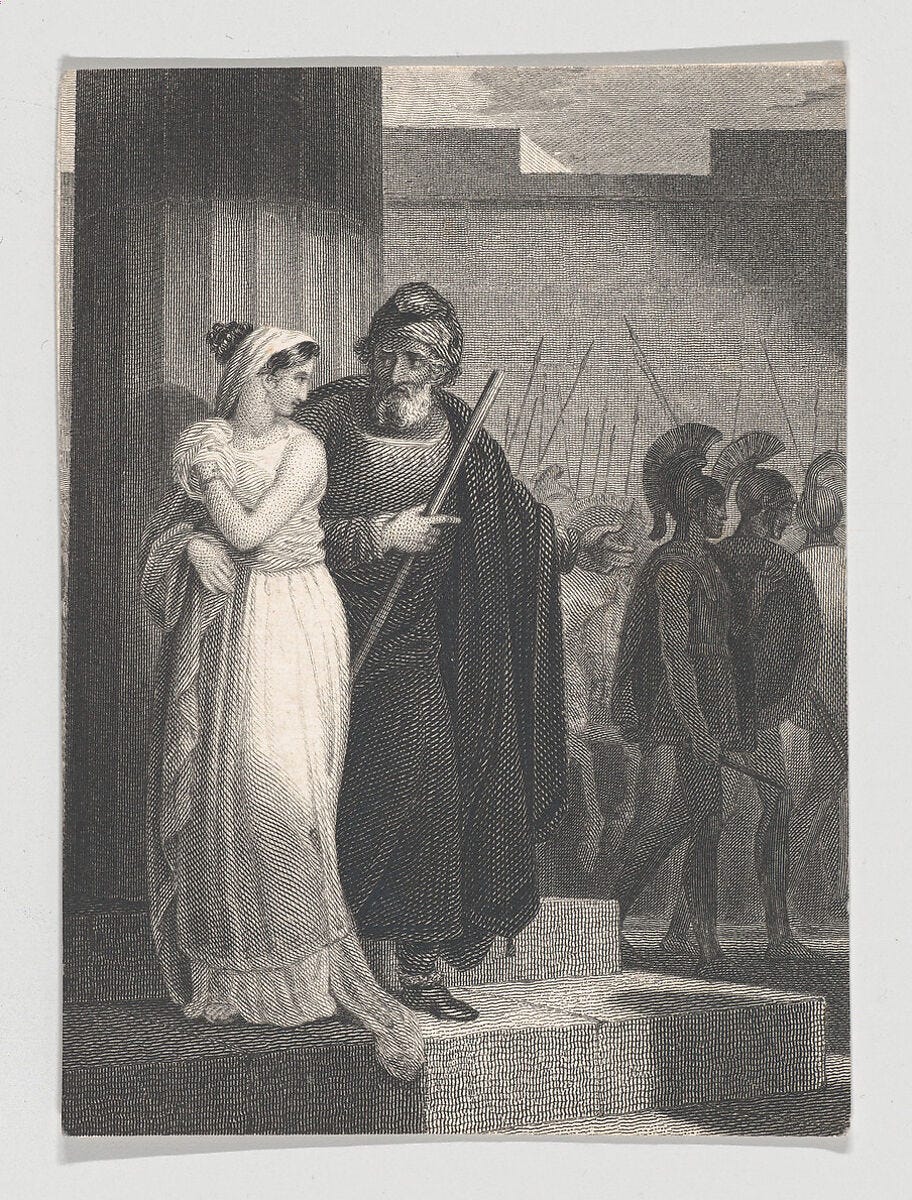
Pandarus is trying his very best to make the idea of Troilus and Criseyde into a reality. But he knows that, first, he must convince his niece that there is good reason to set on this path.
Pandarus’ argument is flowery and rich in a pathos-inducing flow; he says to her:
by my trouthe, I thoughte now if ye
Be fortunat, for now men shal it see.
For every wight som goodly aventure
Somtime is shape, if he it can receiven.
But if that he wol take of it no cure
Whan that it cometh, but wilfully it waiven,
Lo, neither cas ne fortune him deceiven,
But right his verray slouthe and wrecchednesse,
And swich a wight is for to blame, I gesse. (279-287)
Essentially:
Good fortune and adventure come sometimes; one should receive it, if they can. But if one ignores it? Chance or fortune has nothing to do with it. . . this would be a product of one’s own insolence, and the only person to blame would be them.
“I guess,” he adds cheekily to the end.
Whewww, that’s heavy.
I would say Pandarus’ rhetoric does a lot to slyly get under Criseyde’s skin––and this is before he inserts her directly as the individual who must seize their future:
Good aventure, O bele nece, have ye
Ful lightly founden, and ye conne it take.
And for the love of God, and eek of me,
Cacche it anon, lest aventure slake.
What sholde I lenger proces of it make? (288-292)
“What more is there to say?”; “Why spin more yarn?” Pandarus asks (I imagine with imploring, guilt-tripping-relative-puppy eyes).
“For the love of God and of me” consider talking to this man, Troilus. Twist my arm, Criseyde’s probably thinking.
The cherry on top?
He tells her to “Doth what you list to make him live or deye” (322). BUT–
But if ye lete him die, I wol sterve.
Have here my trouthe, nece, I nil nat lien,
Al sholde I with this knif my throte kerve.”
With that the teres breste out of his eyen,
And saide, “If that ye doon us bothe dien
Thus giltelees, thanne have ye fisshed faire.
What mende ye though that we bothe apaire? (323-329)
Um.
Dramatic but effective?
As a reader, this was surprising for me. I knew Pandarus had a certain sensational air to him, but this was an extreme stanza to read.
What do you make of Pandarus’ stake in Troilus and Criseyde’s romance? His role?
As you all have read books 2 and 3 as well, I want to posit a question about how organic their love is; how viable their future is if so much of their foundation has been scaffolded by outside forces (mostly Pandarus but a little of Love-the god).
Criseyde is almost forced to consider a future with Troilus; rhetoric aside, a suicide threat is not an ultimatum that anyone would find easy to swallow.
How does this affect how we might perceive the durability, the sincerity of their relationship? How does our knowledge of the background orchestrations color our perception of their courtship?
Let me know, dear Reader. Until the next <3
Pandarus and his rhetorical manipulation of Trolius and Criseyde reminds me of how the divine constantly interfere in the romances/conflicts of mortals in these myths. On one hand, we dislike Pandarus because of his shady intentions, but on the other hand we have to appreciate his involvement; his interference is the catalyst for the myth. Often we see in the case of young lovers in these myths is that they have no real agency because higher characters are pulling strings. Had it been a god or someone else other than Pandarus, or the method of rhetorical argument different, the role of the intercessor would remain fundamental to the myth convention.
It was shown earlier in the story that Pandarus was quite the man who collected lovers in a joke that Criseyde made early on in the story, right before the manipulation tactics he imposed on her. I honestly think that Pandarus's motive to create a union between Troilus and Criseyde is the thrill that the idea of love offers during the time of war they are in. After all, who doesn't love a love story? I think it was an opportunity for him to live through Troilus, as there were a few references to him talking about love for himself and what that entails. Though disturbing because it's his niece, Criseyde, it wouldn't have been too uncommon for a union between relatives to occur during that time. Though I don't think he was interested in her in that way, he rather loved being the puppeteer to the union itself, as love seemed nowhere within his grasp.